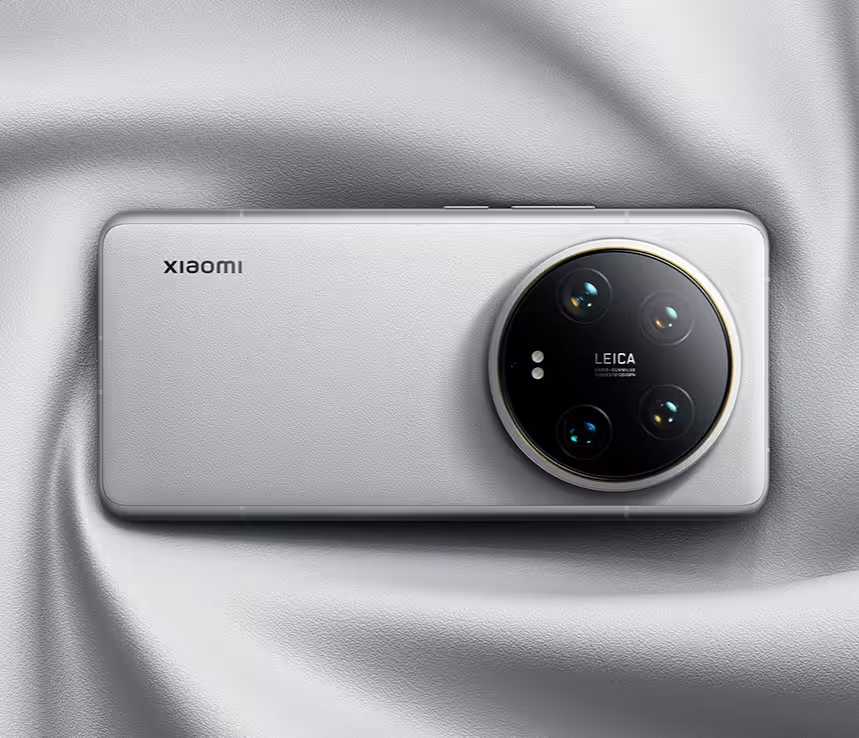
Yes, and it is a real one. Here is what the f/1.63 to f/4.0 aperture actually does, when to change it, and why Xiaomi dropped it on the 15 Ultra.
At a glance
| Spec | Detail |
|---|
| Main camera | 50MP 1-inch sensor, 23mm |
| Aperture | Variable, stepless from f/1.63 to f/4.0 |
| Other cameras | 50MP 3.2x (f/1.8), 50MP 5x periscope (f/2.5), 50MP ultrawide (f/1.8) |
| Which lens is variable | Main camera only |
| Where to set it | Pro mode gives full control |
Yes, the Xiaomi 14 Ultra has a variable aperture
The main camera on the Xiaomi 14 Ultra has a physical aperture that opens and closes, just like a camera lens. It can move smoothly anywhere between f/1.63 and f/4.0. Xiaomi calls it stepless, because it is not limited to two or three fixed settings.
Only the main 23mm camera has it. The ultrawide, 3.2x and 5x cameras all have fixed apertures.
What aperture means, simply
The aperture is the size of the hole that lets light into the camera. The f-number describes that size, and it works backwards. A small number like f/1.63 means a big opening. A bigger number like f/4.0 means a smaller opening.
A big opening lets in more light, so photos are brighter and cleaner at night. It also gives a shallower focus area, so the background gets softer behind a close subject.
A smaller opening lets in less light, but it keeps more of the scene in focus from front to back. Corners also tend to look sharper.
When to use f/1.63
- Night and indoor shots. More light means lower ISO and less noise.
- Close-ups of food, flowers and objects. You get natural background blur without portrait mode.
- Moving subjects in low light. More light lets the camera use a faster shutter speed.
Watch your focus when you shoot very close. At f/1.63 the sharp area can be thin, so the tip of a flower may be sharp while the back petals are soft.
When to use f/4.0
- Landscapes and city scenes. More of the view stays sharp, from nearby rocks to far away buildings.
- Group photos. People standing in two rows all stay in focus.
- Street lights and the sun. A smaller aperture turns bright points of light into star shapes, often called sunstars.
- Bright daylight. It helps avoid overexposed skies.
How to change it
The easiest way to control it is Pro mode in the camera app. You can set the aperture yourself, along with shutter speed, ISO and focus. In the normal photo mode, the phone picks for you based on the scene.
A good habit is to leave it wide open at night and move to around f/4.0 for landscapes and night scenes with street lights on a tripod or steady surface.
Why the effect is smaller than on a big camera
A 1-inch sensor is large for a phone, but much smaller than a full frame camera. Because of that, the blur and depth you see are closer to what f/4.4 and f/11 look like on a full frame camera.
That is still useful. At f/1.63 you get soft backgrounds on close subjects. At f/4.0 you get front to back sharpness that a fixed f/1.63 phone lens cannot give you. The difference is easy to see in real photos, which is why photographers liked this feature so much.
Xiaomi 15 Ultra and newer models
The Xiaomi 15 Ultra dropped the variable aperture. Its main camera has a fixed f/1.63 lens. It is still an excellent camera, but you lose the easy sunstars and the deep focus for landscapes.
The Xiaomi 17 Ultra went a different way. Its main camera is fixed, but its telephoto camera has a variable aperture along with real optical zoom.
So if a variable aperture on the main camera matters to you, the 14 Ultra is still the Xiaomi to get.
Who it’s for
Buy it if you like shooting landscapes, night scenes and close-ups, and want real control over depth of field on your phone.
Skip it if you never change camera settings. The auto mode on a newer phone will serve you just as well.
Alternatives worth a look
- Xiaomi 15 Ultra, fixed aperture, but a stronger 200MP periscope zoom.
The verdict: The Xiaomi 14 Ultra has a true variable aperture on its main camera. Use f/1.63 for low light and blur, and f/4.0 for landscapes and sunstars.